Tuesday, February 14, 2012

Death of Global Warming, Part 5

Myth #9: Modern temperature increases are a direct result of the Earth’s climate exiting the Little Ice Age.

I have not seen anyone make this point but there are many more direct causes for climate than the end of the ice age. This is a myth although there probably aren't a lot of people that believe it.

Myth #10: Global cooling between 1940 and 1970 happened even though anthropogenic CO2 was rising

This is an accurate statement and not a myth. The author admits it is true - then dances around about "the sun", "the volcanos", etc. Since the author admits it is true then we will just stipulate that it is a fact not a myth and move on.

Monday, February 13, 2012

Death of Global Warming, Part 4

Myth #7: Temperatures during the Medieval Warm Period were warmer than modern temperatures.

Just Google "hide the decline" or "Hockey Stick briffa" to see some of the arguments. In a nutshell the Mann hockey graph obscured the fact that the proxies have risen 50% (or less) than the instrumented temperature since 1960. That's a fact and not a debating point. The arctic (Greenland) and antarctic ice cores show the MWP as being warmer and in theory these measures should be more stable than the tree rings. Before 1998 the MWP was believed to be much warmer. If the Medieval temperature anomaly is doubled (to reflect recent proxy performance) it would clearly be warmer. "Sigh" however what this really means is the variability of tree ring response to temperature is so great we can't tell accurately how warm the MWP was and this is just a pissing contest.

More evidence of error comes from the Wegman Report which reviewed the hockey stick and said:

Of the approach used by Mann: "...it is unlikely that the
temperature records and the data derived from the proxies can be adequately modeled
with a simple temperature signal with superimposed noise."

On the hockey stick: "The controversy of Mann’s methods lies in that the
proxies are centered on the mean of the period 1902-1995, rather than on the whole time
period. This mean is, thus, actually decentered low, which will cause it to exhibit a larger
variance, giving it preference for being selected as the first principal component. The net
effect of this decentering using the proxy data in MBH98 and MBH99 is to produce a
“hockey stick” shape."

On his statistics: "We note that there is no evidence that Dr.
Mann or any of the other authors in paleoclimatology studies have had significant
interactions with mainstream statisticians."

On the social network and independence of authors: "Our findings from this analysis suggest that authors in the area of paleoclimate studies are closely connected and thus ‘independent studies’ may not be as independent as they might appear on the surface."

Here are some more interesting arguments:http://joannenova.com.au/2009/12/fraudulent-hockey-sticks-and-hidden-data/

Myth #8: The existence of the Medieval Warm Period has been ignored in order to support anthropogenic global heating..
This question brings Ayn Rand and “Why don’t you believe in housewives?” to mind. I don't know why they are doing it - but they are (at least in the case of Mann).

The problem is that the proxies peaked in 1940. The Mann "Hockey Stick" graph used strategically placed instrument data to obscure this fact. For a discussion of the proxy problems:
http://icecap.us/images/uploads/Holocene,Historicandrecentglobaltemperatures.pdf

From a proxy perspective 1940 may/may not be warmer than the MWP. The 21st century definitely isn't. Given that the Vikings aren't growing grain in Greenland like they were during the MWP, the MWP was probably warmer.

On rereading the source discussion - he appears to argue that there are enough errors in the data that we don't know for sure when the warmest period was. Sounds good - but Mann did try to eliminate the MWP.

Death of Global Warming, Part 3

Myth #5: CO2 is such a weak greenhouse gas that it cannot be the cause of the observed warming.

Another straw man. Most people aren't arguing that it can't be, they're arguing that it isn't or that it is a result, etc.

CO2 has increased from 366.65 (1998) to around 393 (today). Using one of the IPCC forcing equations:

Forcing in w/m2 = 5.35*ln(393/366.65) = .37 w/m2

This is good for about 0.1 degrees Celsius. Has the climate warmed 0.1 degrees in the last 13 years?

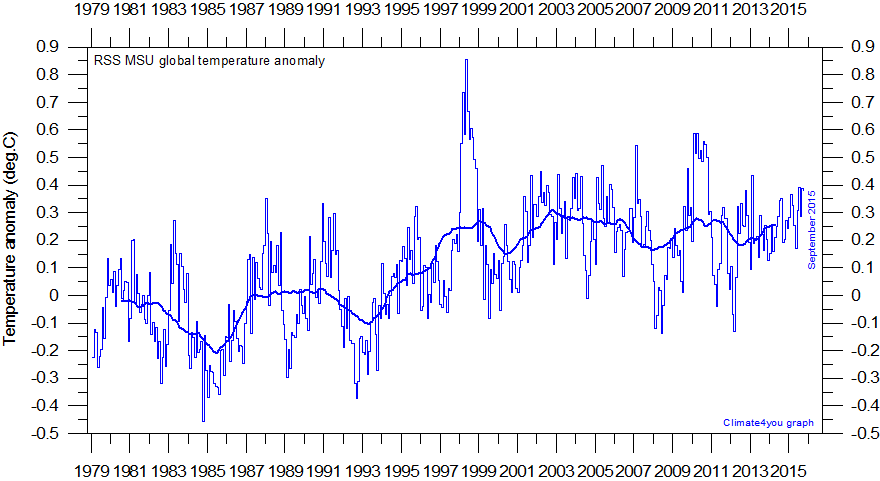
Courtesy of www.climate4you.com is the UAH temperature anomaly graph.

If you follow the link to the graph you get the feeling we are 0.3 degrees cooler, despite a 7% increase in CO2. This isn't much evidence of CO2 forcing.

The temperature anomaly is somewhere between 0 and .6 degrees Celsius. The CO2 level has gone up 113 ppm. This should have caused a forcing (using the above equation) of 1.8 w/m2 or 0.33 degrees Celcius.

Given that the .6 estimate includes IHI effects, data maturity changes, etc. the actual value is somewhere between 0 and 0.6. 0.3 or 0.4 would be good choices. This would mean that the IPCC estimates of CO2 forcing are correct but the predictions of 5x water vapor forcing are not, the net feedback is approximately zero.

Since fossil fuels are responsible for 30% of the CO2 increase the temperature rise due to fossil fuels is 0.1 degrees C.

Bottom line - CO2 has an effect and causes some of the warming, not a worrisome amount, but some.

Myth #6: CO2 concentrations are not correlated with global temperature due to periods in the geologic history when CO2 was higher and the planet was in an ice age.

This myth is deceptive - the CO2 concentrations do generally correlate with temperature - in that rising temperatures cause a delayed increase in CO2.

The author does a lot of dancing about late Ordovecian period when there was an ice age with CO2 levels 14x the current levels. Given that the historic CO2 increases trail warming by centuries, historically temperature drives CO2. Claiming that historically CO2 drove temperature is simply deceitfully. The cause has to precede the effect. Also there is published literature to the effect that CO2 has to be below 600 ppm to have a ice age. The historic record has exceptions that make this look a little dubious (14x is a lot more than 600ppm).

So the myth is generally untrue - but only because temperature drives CO2 levels.

Death of Global Warming, Part 2

Myth #3: Humans are not the source of the recent increase in atmospheric CO2 concentration.

I have to give the author props for this one. Given the analysis in part one, humans are the major source of CO2.

However there is some evidence that that carbon isotope ratios aren't definitive. Further, a Japanese enviromental satellite indicates that the sources of CO2 are Brazil, Africa, and Asia. North America (US/Canada) and Northern Europe are net sinks of CO2.


Myth #4: CO2 is rising at 0.38% per year, not 1% per year as the IPCC Third Assessment Report claimed.

For 2011 the increase was 1.96 ppm. So, CO2 is going up 2.0 ppm. Concentration is 400 ppm (more or less). That would mean 0.5% per year. So the truth is in the middle. The IPCC is absolutely wrong and the myth is kind of wrong. We grade a 100% miss as wrong. 0.38% (roughly 31 percent off) is bad at math wrong.

Death of Global Warming, Part 1

Saw this website that claimed to refute the "Deniers":

Anti-global heating claims – a reasonably thorough debunking


Before we start swinging our ax to chop through the nonsense list, let's first dispose of the prelude.

0. "The Earth is heating up, and human beings burning fossil fuels are the dominant cause"
This is a damned lie. In two parts.
a. Looking at the UAH global temperature anomaly it is really hard to see any trend in the last 10-15 years. Climate4you.com has all the various anomalies. The NCDC and GISS maturity (the fact that historic data is being changed) render them unusable as a reference. Bob Tisdale has a good example of the problem. The data has been manipulated to more closely resemble the climate model results.

b. Wikipedia (no friend of "Deniers") list fossil fuel use as contributing 10 GT of carbon per year and other causes (mostly land use changes) causing 25 GT of additional carbon per year. Burning down rainforests to grow palm oil for biodiesel puts more carbon into the atmosphere than fossil fuels. At any rate burning fossil fuels is 30% of the problem.

1. Myth #1: All the CO2 in the air at present comes from the mantle. I don't know what to do with this statement. It is true that all the CO2 originally came from the mantle - the CO2 was there before the plants or animals and volcanoes are constantly injecting more CO2. However if you divide 10**4 or 10**6 (the ratio of CO2 from the mantle to anthropomorphic CO2) by 10**9 (a billion years) you get nada (0.001 or less), this is why volcanoes and man-made CO2 are always compared. All that CO2 is lime, coal, or oil. However this is apparently a straw man. The Khilyuk and Chilingar article was in a geology journal, was looking at the temperature over long time frames (by and large) based on best information and accidentally stepped on some AGW toes.

Lets look at the CO2 currently in the atmosphere. The vast majority of the CO2 in the atmosphere is produced animals and consumed by plants. There are 730 Gigatons in the atmosphere and photosynthesis converts 150-175 Gigatons a year. So the average lifetime of CO2 in the atmosphere is in the range of 5-7 years. There is a common lie that the lifetime of CO2 is 100 years but if you replace between 20% and 25% of the atmospheric CO2 per year, well - just do the math.

The author tries to make the point that fossil fuel CO2 is a significant portion of the CO2 in the atmosphere. The fossil fuel CO2 is only 1/17 (10/170 Gigatons) the amount normally consumed by plants. According to USDA studies doubled CO2 results in 50% greater growth (and presumably 50% more CO2 consumption) and consumption continues to increase to 1200ppm. For example: at 680ppm of CO2 cotton produces a 200% higher yield and 87% more mass than at 340 ppm. At 200 ppm of CO2 land plant photosynthesis stops - see this chart from www.Hydrofarm.com. 280 ppm of CO2 is not ideal for plants, being almost a starvation level of CO2 - it is the result of competition for resources. So, yes there is a significant amount of man-made CO2 but it is rapidly compensated for by increased plant growth.

The only way to significantly increase CO2 is to completely cut down all the rainforests or empty the oceans.

2. Myth #2: Increasing CO2 in the air is due to gases coming out of solution as the ocean heats up. "The source of the CO2 in the air is thermal heating of the ocean causing dissolved gases like CO2 to come out of solution and enter the atmosphere"
I don't know anyone who actually says this but the literal statement is indeed a myth. However I read through the Monckton article that was linked and searched on solution, heating, and other key words in the quoted statement and Monckton didn't make the statement. So I don't know where the author's myth comes from.

Although this is another straw man, let's sort out the facts. The amount of natural CO2 emitted due to increasing land temperature is evident but doesn't appear to have been quantified, doesn't appear to be more than man-made emission, and since there is no reason to guess, we'll have to ignore it for now. We know from myth 1 that we are injecting 1.3% (10/730 Gigatons) new CO2 into the atmosphere on a yearly basis. We know from the prelude analysis that 3.4% (25/730 Gigatons) is due to land use changes and other issues (from Wikipedia). Taken together this is 4.7% or 18ppm (.047 * 400ppm). Here is the only estimate I could find for ocean heating induced CO2 of 20 - 40 ppm per degree of warming. So if we assume the worst case and average a one degree increase over a century we get .4 ppm per year which is a very small increase compared to anthropomorphic CO2.

However the rate of increase of CO2 is not 18.4 ppm. The CO2 is increasing at 2.0 ppm and the current level is almost 400 ppm so the rate of increase is 0.5%. This is mostly caused by anthropomorphic CO2. Much of the "new" CO2 is absorbed by the ocean or converted by plants. The ocean is probably a net absorber of CO2.

The author tries to make the point that CO2 in the ocean is increasing and given that the atmospheric CO2 concentration (and thus the ocean concentration) is rising faster than the ocean heat induced outgassing, it is expected that the ocean would still be a net carbon sink.

Just note that there was some switching above between gigatons and ppm (730 gigatons of carbon is about 390 ppm of CO2).